Strong Women, Weak Men (1968)
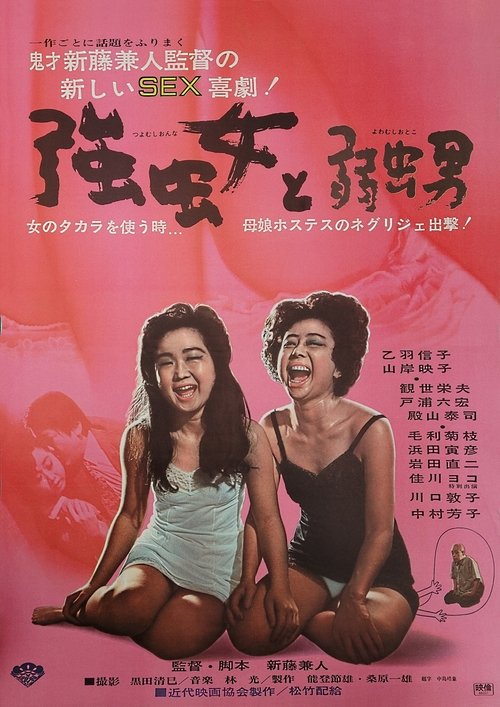
After the closure of a coal mine leaves her husband unemployed, Fumiko travels from Kyushu to Kyoto with her daughter Kimiko, and they become hostesses at a cabaret.
Director: Kaneto Shindo
Genre: Comedy, Drama
Runtime: 98 min
Release Date: June 30, 1968
Cast
- Nobuko Otowa - Fumiko
- Eiko Yamagishi - Kimiko
- Taiji Tonoyama - Zenzo
- Hideo Kanze - Gonbee
- Daigo Kusano - Kawahara
- Atsuko Kawaguchi - Omitsu
- Torahiko Hamada - Kumagai
- Rokkō Toura - Chief
- Kozo Yamamura
- Masaru Miyata
Screenplay
- Kaneto Shindo (Screenplay)
Music: Hikaru Hayashi
Cinematography: Kiyomi Kuroda
Editing: Hisao Enoki
Production: Kindai Eiga Kyokai
Country: Japan
Language: 日本語
Original Language: ja
Themes
Poverty Cycle and Hopelessness, Social Commentary and Reflection, Crushing Despair and the Void, Class Warfare and Inequality, A Weary Soul and Exhaustion
Keywords
cabaret, poverty, class differences, overbearing mother, farmer, unemployment, gold digger, land owner, hostess, closed mine, migrant worker, kyoto, japan, japanese family, welfare, mother and daughter
Similar Movies
More Films by Director: Kaneto Shindo
Frequently Asked Questions
- What is Strong Women, Weak Men about?
- After the closure of a coal mine leaves her husband unemployed, Fumiko travels from Kyushu to Kyoto with her daughter Kimiko, and they become hostesses at a cabaret.
- Who directed Strong Women, Weak Men?
- Strong Women, Weak Men was directed by Kaneto Shindo.
- Who stars in Strong Women, Weak Men?
- Strong Women, Weak Men stars Nobuko Otowa, Eiko Yamagishi, Taiji Tonoyama, Hideo Kanze, Daigo Kusano, Atsuko Kawaguchi.
- How long is Strong Women, Weak Men?
- Strong Women, Weak Men has a runtime of 1h 38m (98 minutes).
- What genre is Strong Women, Weak Men?
- Strong Women, Weak Men is a Comedy, Drama film.
- Where was Strong Women, Weak Men produced?
- Strong Women, Weak Men was produced in Japan.
- What are the themes of Strong Women, Weak Men?
- The themes of Strong Women, Weak Men include: Poverty Cycle and Hopelessness, Social Commentary and Reflection, Crushing Despair and the Void, Class Warfare and Inequality, A Weary Soul and Exhaustion.