Ordet (1955)
A Legend for Today
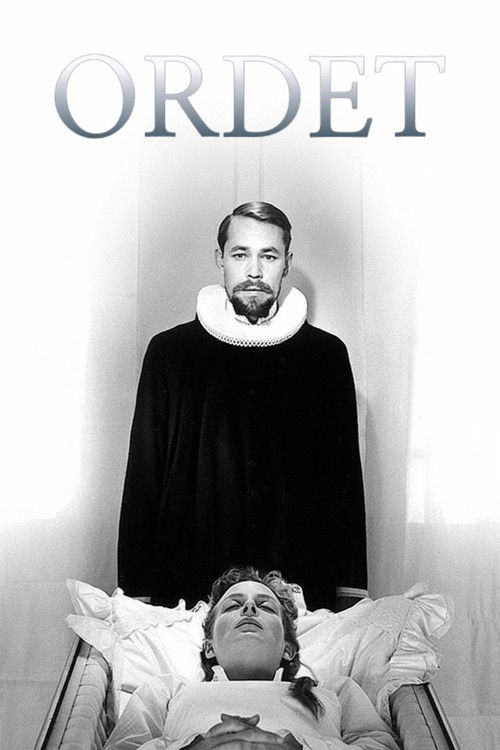
The three sons of devout Danish farmer Morten have widely disparate religious beliefs. Youngest son Anders shares his father's religion, but eldest son Mikkel has lost his faith, while middle child Johannes has become delusional and proclaims that he is Jesus Christ himself. When Mikkel's wife, Inger goes into a difficult childbirth, everyone's beliefs are put to the test.
Director: Carl Theodor Dreyer
Genre: Drama
Runtime: 125 min
Release Date: January 9, 1955
Cast
- Henrik Malberg - Morten Borgen (uncredited)
- Birgitte Federspiel - Inger Borgen (uncredited)
- Emil Hass Christensen - Mikkel Borgen (uncredited)
- Preben Lerdorff Rye - Johannes Borgen (uncredited)
- Cay Kristiansen - Anders Borgen (uncredited)
- Ejner Federspiel - Peter Petersen (uncredited)
- Gerda Nielsen - Anne Petersen (uncredited)
- Sylvia Eckhausen - Kirstin Petersen (uncredited)
- Ann Elisabeth Groth - Maren Borgen (uncredited)
- Susanne Rud - Lilleinger Borgen (uncredited)
Screenplay
- Kaj Munk (Story)
- Carl Theodor Dreyer (Screenplay)
Music: Poul Schierbeck
Cinematography: Henning Bendtsen
Editing: Edith Schlüssel
Production: Palladium
Country: Denmark
Language: Dansk
Original Language: da
Themes
Unwavering Faith and Hope, Religious Fundamentalism and Social Conflict, Religious Persecution and Search for Tolerance, Religious Divide and Conflict of Faith, Faith, Religion and Spirituality
Keywords
faith, religion, black and white, religious fundamentalism, pregnant wife
Trailer
Ordet TrailerSimilar Movies
More Films by Director: Carl Theodor Dreyer
More Films in Genre: Drama
Frequently Asked Questions
- What is Ordet about?
- The three sons of devout Danish farmer Morten have widely disparate religious beliefs. Youngest son Anders shares his father's religion, but eldest son Mikkel has lost his faith, while middle child Johannes has become delusional and proclaims that he is Jesus Christ himself. When Mikkel's wife, Inger goes into a difficult childbirth, everyone's beliefs are put to the test.
- Who directed Ordet?
- Ordet was directed by Carl Theodor Dreyer.
- Who stars in Ordet?
- Ordet stars Henrik Malberg, Birgitte Federspiel, Emil Hass Christensen, Preben Lerdorff Rye, Cay Kristiansen, Ejner Federspiel.
- How long is Ordet?
- Ordet has a runtime of 2h 5m (125 minutes).
- What genre is Ordet?
- Ordet is a Drama film.
- Where was Ordet produced?
- Ordet was produced in Denmark.
- What are the themes of Ordet?
- The themes of Ordet include: Unwavering Faith and Hope, Religious Fundamentalism and Social Conflict, Religious Persecution and Search for Tolerance, Religious Divide and Conflict of Faith, Faith, Religion and Spirituality.