Poulenc's The Human Voice / Bartók's Bluebeard's Castle (2018)
A unique merger of two one-act operas
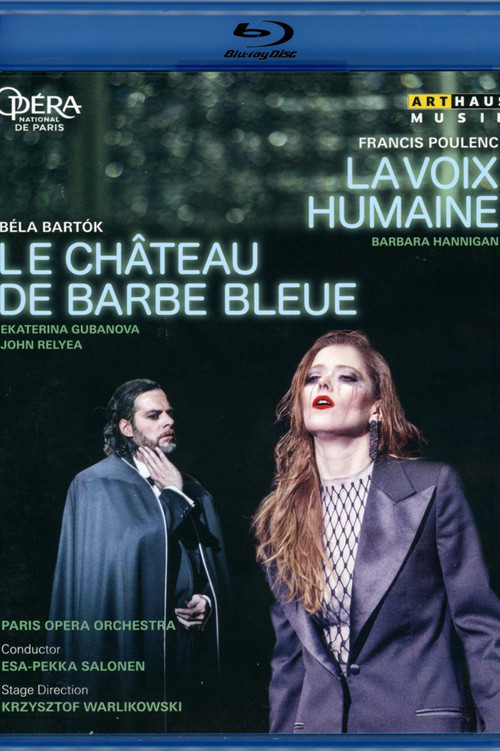
Running through Bartók’s disenchanted tale, whose haunting music was initially condemned as unplayable, and the expression of despair in Poulenc’s monologue, the director Krzysztof Warlikowski perceives a shared dramatic thread, a shared feminine consciousness and a shared sense of imprisonment and suffocation: for the woman who penetrates the confines of Bluebeard’s castle and Elle, the woman who clings to a telephone conversation with a man as the only thing worth living for, are condemned to share the same fate. And this man she speaks to, does he really exist? Unless the director has interpreted Cocteau’s words to the letter and the telephone has become a “terrifying weapon that leaves no trace, makes no noise”…
Cast
- John Relyea - Duc Barbe-Bleue
- Ekaterina Gubanova - Judith
- Claude Bardouil - Him (silent role)
- Barbara Hannigan - Her
- Esa-Pekka Salonen - Self - Conductor
- Paris Opera Orchestra - Self
Screenplay
Themes
Opera Grandeur and Dramatic Voices, Opera Stage and Dramatic Arias, Classical Music and Art
Keywords
opera
Frequently Asked Questions
- What is Poulenc's The Human Voice / Bartók's Bluebeard's Castle about?
- Running through Bartók’s disenchanted tale, whose haunting music was initially condemned as unplayable, and the expression of despair in Poulenc’s monologue, the director Krzysztof Warlikowski perceives a shared dramatic thread, a shared feminine consciousness and a shared sense of imprisonment and suffocation: for the woman who penetrates the confines of Bluebeard’s castle and Elle, the woman who clings to a telephone conversation with a man as the only thing worth living for, are condemned to share the same fate. And this man she speaks to, does he really exist? Unless the director has interpreted Cocteau’s words to the letter and the telephone has become a “terrifying weapon that leaves no trace, makes no noise”…
- Who directed Poulenc's The Human Voice / Bartók's Bluebeard's Castle?
- Poulenc's The Human Voice / Bartók's Bluebeard's Castle was directed by Stéphane Metge, Stéphane Lissner.
- Who stars in Poulenc's The Human Voice / Bartók's Bluebeard's Castle?
- Poulenc's The Human Voice / Bartók's Bluebeard's Castle stars John Relyea, Ekaterina Gubanova, Claude Bardouil, Barbara Hannigan, Esa-Pekka Salonen, Paris Opera Orchestra.
- How long is Poulenc's The Human Voice / Bartók's Bluebeard's Castle?
- Poulenc's The Human Voice / Bartók's Bluebeard's Castle has a runtime of 2h 1m (121 minutes).
- What genre is Poulenc's The Human Voice / Bartók's Bluebeard's Castle?
- Poulenc's The Human Voice / Bartók's Bluebeard's Castle is a Music, Drama film.
- Where was Poulenc's The Human Voice / Bartók's Bluebeard's Castle produced?
- Poulenc's The Human Voice / Bartók's Bluebeard's Castle was produced in France, Germany.
- What are the themes of Poulenc's The Human Voice / Bartók's Bluebeard's Castle?
- The themes of Poulenc's The Human Voice / Bartók's Bluebeard's Castle include: Opera Grandeur and Dramatic Voices, Opera Stage and Dramatic Arias, Classical Music and Art.